
High-speed data acquisition with a FPGA onboard a sounding rocket
Rocksat-X is a year long NASA program that allows student to design, build test and fly student build experiments on a sounding rocket. I got the opportunity to participate in the 2024 WV Rocksat-X program through WVU and help develop RF instrumentation using a Redpitaya STEMLab.
This was funded through the WV Space grant consortium (WV-SGC) and 5 schools in the state of West Virginia were participating to build a payload to fly as a part the NASA Rocksat program. I joined the team after the design phase to help implement the WVU experiment, which was focused on measure electric fields during flight.
Basic experiment
The WVU group working on the project had proposed to build a Langmuir probe and wave measurement device similar to what was flown in MAVEN. The minimum success criteria had been set to measure the electron density $n_e$ with a minimum rate of 1 Hz.
My contribution
Having had some experience with FPGA and embeded programming. I took on the task of implementing the software needed for the experiment. We chose a Redpitaya STEMLab 125-14 for the final design.
- Drive the motors for antenna extension
- Drive and sample the Langmuir probe to get 1 Hz electron density data
- Generate random numbers and save data 125 MHz
I was able to successfully implement all three of these goals using a Matlab Simulink and Xilinx. The design is shown below,
Find a good image here to show the matlab diagram
This was then integrated with a modified FPGA firmware such that antenna extension/retraction and all experiments can be controlled using inputs from a c/python program running on the Redpitaya OS. The final binary FPGA image and the experiment controller programs can be found here
How did we do
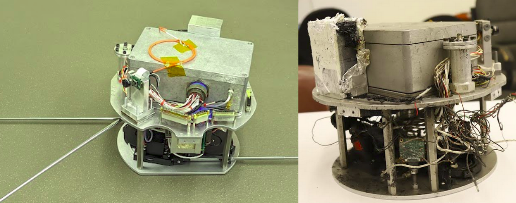
Testing and launch went well. The payload was recovered and most parts of the experiment worked as expected. The team went on to analyse the Langmuir probe data and it was presented in AGU 2024 and 2025 by Dylan. The RF experiment had collected data but no significant signals were identified. We concluded this was probably due to insufficient amplification on the RF pre-amp.
For me this was a great learning experience to polish up my experimental skills and contribute to a project and actually use an FPGA for science !