<?xml version="1.0" encoding="utf-8"?><feed xmlns="http://www.w3.org/2005/Atom" ><generator uri="https://jekyllrb.com/" version="3.10.0">Jekyll</generator><link href="https://hasithperera.github.io/feed.xml" rel="self" type="application/atom+xml" /><link href="https://hasithperera.github.io/" rel="alternate" type="text/html" /><updated>2026-07-07T16:47:04+00:00</updated><id>https://hasithperera.github.io/feed.xml</id><title type="html">Hasith Perera</title><subtitle>Hasith Perera&apos;s personal website</subtitle><author><name>Hasith Perera</name><email>aperera@clemson.edu</email></author><entry><title type="html">Post: Test Gallery</title><link href="https://hasithperera.github.io/blog/test-gallery/" rel="alternate" type="text/html" title="Post: Test Gallery" /><published>2026-03-09T00:00:00+00:00</published><updated>2026-03-09T00:00:00+00:00</updated><id>https://hasithperera.github.io/blog/test-gallery</id><content type="html" xml:base="https://hasithperera.github.io/blog/test-gallery/"><![CDATA[<p>This post is a sample post to test a external photo Gallery</p>

<figure class="third ">
  
    
      <a href="https://flic.kr/p/8a6Ven">
          <img src="https://farm2.staticflickr.com/1272/4697500467_8294dac099_q.jpg" alt="Black and grays with a hint of green" />
      </a>


      <a href="https://flic.kr/p/8a738X">
          <img src="https://farm5.staticflickr.com/4029/4697523701_249e93ba23_q.jpg" alt="Made for open text placement" />
      </a>


      <a href="https://flic.kr/p/8a6VXP">
          <img src="https://farm5.staticflickr.com/4046/4697502929_72c612c636_q.jpg" alt="Fog in the trees" />
      </a>


    <figcaption>This is a second gallery example with images hosted externally.
</figcaption>
  
</figure>]]></content><author><name>Hasith Perera</name><email>aperera@clemson.edu</email></author><category term="blog" /><category term="test" /><summary type="html"><![CDATA[This post is a sample post to test a external photo Gallery]]></summary></entry><entry><title type="html">High-speed data acquisition with a FPGA onboard a sounding rocket</title><link href="https://hasithperera.github.io/blog/WVU-Rocksat-2024/" rel="alternate" type="text/html" title="High-speed data acquisition with a FPGA onboard a sounding rocket" /><published>2024-12-22T00:00:00+00:00</published><updated>2024-12-22T00:00:00+00:00</updated><id>https://hasithperera.github.io/blog/WVU-Rocksat-2024</id><content type="html" xml:base="https://hasithperera.github.io/blog/WVU-Rocksat-2024/"><![CDATA[<p style="text-align: justify;">Rocksat-X is a year long <a href="https://www.nasa.gov/nasa-rocksat-program/">NASA program</a> that allows student to design, build test and fly student build experiments on a sounding rocket. I got the opportunity to participate in the <strong>2024 WV Rocksat-X</strong> program through WVU and help develop RF instrumentation using a Redpitaya STEMLab.</p>

<p style="text-align: justify;">This was funded through the <a href="https://www.wvspacegrant.org/">WV Space grant consortium (WV-SGC)</a> and 5 schools in the state of West Virginia were participating to build a payload to fly as a part the NASA Rocksat  program.  I joined the team after the design phase to help implement the WVU experiment, which was focused on measure electric fields during flight.</p>
<h2 id="basic-experiment">Basic experiment</h2>

<p style="text-align: justify;">The WVU group working on the project had proposed to build a Langmuir probe and wave measurement device similar to what was flown in <a href="https://science.nasa.gov/resource/langmuir-probe-and-waves-instrument-for-maven-spacecraft/">MAVEN</a>. The minimum success criteria  had been set to measure the electron density $n_e$ with a minimum rate of  1 Hz.</p>

<h2 id="my-contribution">My contribution</h2>

<p style="text-align: justify;">Having had some experience with FPGA and embeded programming. I took on the task of implementing the software needed for the experiment. We chose a <a href="https://redpitaya.com/stemlab-125-14/">Redpitaya STEMLab 125-14</a> for the final design.</p>

<ul>
  <li>Drive the motors for antenna extension</li>
  <li>Drive and sample the Langmuir probe to get 1 Hz electron density data</li>
  <li>Generate random numbers and save data 125 MHz</li>
</ul>

<p>I was able to successfully implement all three of these goals using a Matlab Simulink and Xilinx. The design is shown below,</p>

<p><code class="language-plaintext highlighter-rouge">Find a good image here to show the matlab diagram</code></p>

<p style="text-align: justify;">This was then integrated with  a modified FPGA firmware such that antenna extension/retraction and all experiments can be controlled using inputs from a c/python program running on the Redpitaya OS. The final binary FPGA image and the experiment controller programs can be found <a href="https://github.com/hasithperera/Rocksat-main">here</a></p>

<h2 id="how-did-we-do">How did we do</h2>

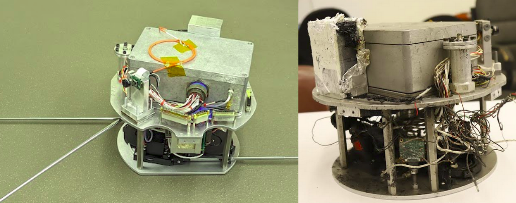
<figure style="width: 50%" class="align-right">
  <img src="/assets/images/posts/rocksatx_pre_post.png" alt="" />
  <figcaption class="figure-caption text-center"> Rocksat-x 2024 WV payload. Left image shows all the antennas deployed in the lab. Right show the payload after reentry and recovery </figcaption>
</figure>

<p>Testing and launch went well. The payload was recovered and most parts of the experiment worked as expected. The team went on to analyse the Langmuir probe  data and it was presented in AGU 2024 and 2025 by Dylan.  The RF experiment had collected data but no significant signals were identified. We concluded this was probably due to insufficient amplification on the RF pre-amp.</p>

<p>For me this was a great learning experience to polish up my experimental skills  and contribute to a project and actually use an FPGA for science !</p>]]></content><author><name>Hasith Perera</name><email>aperera@clemson.edu</email></author><category term="blog" /><category term="radio" /><category term="other" /><summary type="html"><![CDATA[Rocksat-X is a year long NASA program that allows student to design, build test and fly student build experiments on a sounding rocket. I got the opportunity to participate in the 2024 WV Rocksat-X program through WVU and help develop RF instrumentation using a Redpitaya STEMLab.]]></summary></entry><entry><title type="html">Eclipse hunting - Jaffna 2019</title><link href="https://hasithperera.github.io/blog/Jaffna-Eclipse/" rel="alternate" type="text/html" title="Eclipse hunting - Jaffna 2019" /><published>2019-12-28T00:00:00+00:00</published><updated>2019-12-28T00:00:00+00:00</updated><id>https://hasithperera.github.io/blog/Jaffna-Eclipse</id><content type="html" xml:base="https://hasithperera.github.io/blog/Jaffna-Eclipse/"><![CDATA[<p style="text-align: justify;">Hearing about the upcoming <em>Annular Solar eclipse</em> through social media and the fact that Sri Lanka was in the middle of the <em>path of annuality</em> overwhelmed me with the idea that I should really observer this. Even though I was enthusiastic about science from a young age, this was the first time I was matured enough to understand the importance and the uniqueness of this life time opportunity . I wanted to get the maximum out of it.</p>

<h2 id="getting-ready-for-the-eclipse">Getting ready for the eclipse</h2>

<p style="text-align: justify;">After reading up online about solar eclipse observation, it was clear to me that a few things had to be done before-hand in order to prepare for this event. Finding a location to observe and some suitable equipment was at the top of my to-do list. I had a tripod and my Nikon DSLR, however a decent solar filter was one of the main components I was missing. I was able to find some online but unfortunately the timing was two tight and non of them shipped directly to Sri Lanka. Without the filters this whole thing was just another dream. I turned to a couple of my friends who were out side of Sri Lanka to try to see if I could ask one of them to post it to me and <a href="https://www.facebook.com/pamitha.gunarathne">Pamitha</a> who had recently migrated to Australia for his studies agreed to re-post it to me. Within two days my order was processed and it was a 2 week wait till I finally got the filters.</p>

<p style="text-align: justify;">The only remaining major decision was the location of observation. The eclipse was visible to the entire country to varying degrees. Colombo was on the partial eclipse zone with a maximum of 88% covering of the Solar disk. However northern parts of Sri Lanka (Jaffna and Trincomalee) was in the annular eclipse zone. Over the next few days I convinced my self saying “Why not go there and get the full experience. Its just 400 km not the end of the world right….” After considering my options I was able to convince my parents to agree to a 5 day trip to Jaffna giving us the needed time to visit Jaffna and also to get to be there just in time there for the eclipse.</p>

<p style="text-align: justify;">On the 23rd of December we left home packed for a 5 day trip our first stop was at Sigiriya. The next day we reached Jaffna and we were also able to scout out a suitable location. After a good nights sleep I spent the better part of the Christmas day trying out suitable settings. We were able to visit a couple of key attractions in Jaffna including the Fort and the Nallur Temple.</p>

<h2 id="finally-clear-skys-">Finally clear skys !!</h2>

<p style="text-align: justify;">Finally a clear sky! this was the first thing that came to mind. December 26th early morning after a quick breakfast, packed with all the gear we set out on the uneven roads of <em>Ariyalai</em>, to the spot where we had checked out the previous day. Farmers and village fork were starting there day and were going about there business as usual.</p>

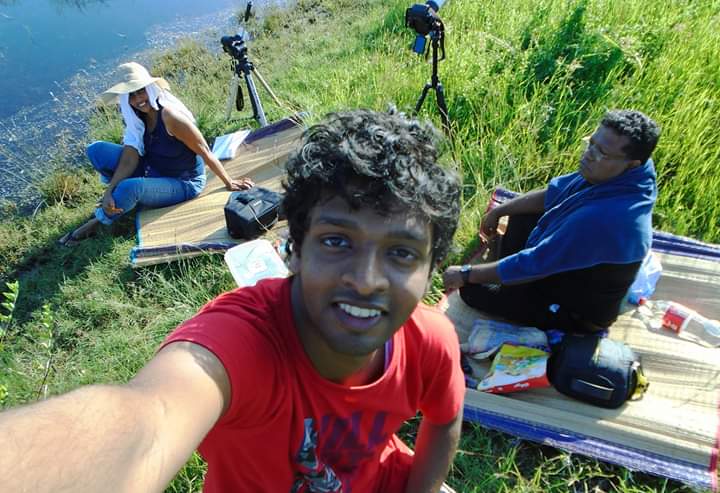
<figure style="width: 50%" class="align-right">
  <img src="/assets/images/posts/jaffna_eclipse_1.jpg" alt="" />
  <figcaption class="figure-caption text-center"> Our eclipse watch party</figcaption>
</figure>

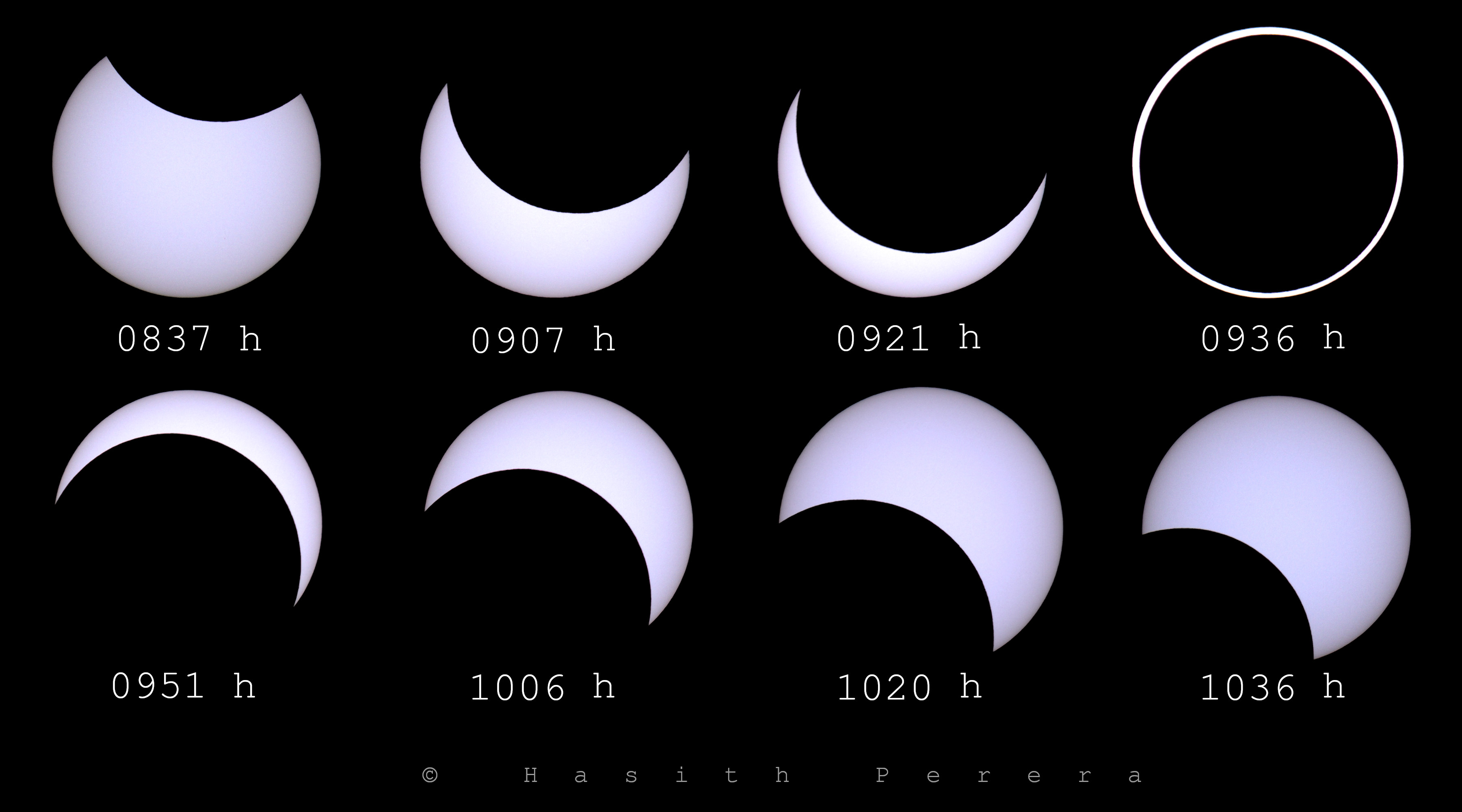
<p style="text-align: justify;">We parked nearby and settled on the location without any incident. At 0809 h we witnessed the initial contact and the next three hours were filled with excitement and a sense of accomplishment. The photos turned out to be great despite a few mistakes in the timing.</p>

<figure style="width: 100%" class="align-right">
  <img src="/assets/images/posts/jaffna_eclipse_2.jpg" alt="" />
  <figcaption class="figure-caption text-center"> A composite image observed during the 2019 annular eclipse from Ariyalai, Jaffna, Sri Lanka</figcaption>
</figure>

<p>At the end of the day the whole experience was unforgettable. It was totally worth driving 400 km :)</p>]]></content><author><name>Hasith Perera</name><email>aperera@clemson.edu</email></author><category term="blog" /><category term="eclipse" /><category term="other" /><summary type="html"><![CDATA[Hearing about the upcoming Annular Solar eclipse through social media and the fact that Sri Lanka was in the middle of the path of annuality overwhelmed me with the idea that I should really observer this. Even though I was enthusiastic about science from a young age, this was the first time I was matured enough to understand the importance and the uniqueness of this life time opportunity . I wanted to get the maximum out of it.]]></summary></entry></feed>